Likes, Shares, and Acquisitions: What Curators Really Think When a Work Goes Viral
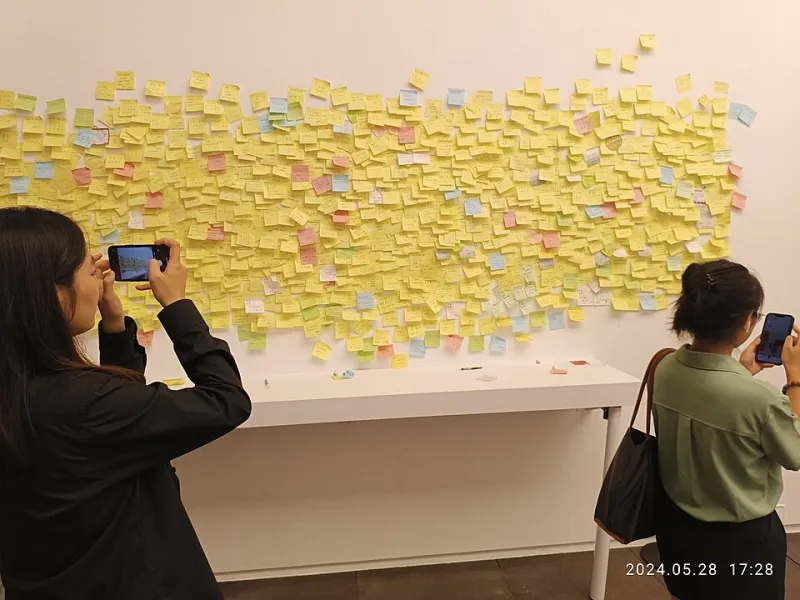
Photo: TANNMY NAISZE Wanguo, CC0, via Wikimedia Commons
There is a particular kind of artwork that museum professionals can identify almost immediately. It tends to involve immersive lighting, a reflective surface, or a bold typographic statement rendered in neon. It photographs beautifully. It generates lines around the block. And it makes certain curators quietly uncomfortable in ways they rarely say out loud — at least not on the record.
At Ask A Curator, we asked them to say it on the record.
What follows is a candid account of how curators at American institutions are grappling with one of the more quietly contentious debates in the contemporary museum world: whether the metrics of social media should carry any weight in the decisions that have traditionally been governed by scholarship, provenance, and art historical consequence.
The Phenomenon Nobody Wants to Name First
The term "Instagram art" has become something of a loaded shorthand — a phrase that simultaneously describes a genuine cultural phenomenon and, depending on who is using it, functions as a subtle dismissal. Works by artists like Yayoi Kusama, whose Infinity Mirror Rooms have generated millions of posts across platforms, or the immersive environments produced by teamLab, have drawn audiences to museums in numbers that many institutions struggled to achieve with more traditionally celebrated programming.
For curators trained in rigorous art historical methodology, this creates a genuine intellectual tension. "There's a reflex in our field to treat popularity as a warning sign," acknowledged one senior curator at a major East Coast museum, who requested anonymity to speak freely. "We've been conditioned to be suspicious of anything that feels too accessible, too immediately gratifying. And I think that reflex deserves to be interrogated."
Not every curator is willing to interrogate it, however. Several professionals we contacted declined to participate in this piece specifically because, as one put it, "the framing puts us in the position of either endorsing something we have reservations about or sounding like elitists — and neither is comfortable."
That discomfort is, arguably, precisely the point.
Accessibility Versus Merit: A False Dichotomy?
The more thoughtful voices in this conversation push back against the idea that virality and artistic significance are mutually exclusive categories. "We need to be careful not to confuse cause and effect," said one curator of contemporary art at a Midwest institution. "Kusama was a historically significant artist decades before Instagram existed. The platform amplified her reach; it didn't manufacture her importance. Those are very different things."
The distinction matters enormously when the conversation shifts from exhibition programming to acquisition. Museums acquire works for their permanent collections with the expectation of stewardship across generations. A work that dominates social feeds in 2024 may carry entirely different cultural weight in 2044. "My job is not to collect this moment," one acquisitions specialist explained. "My job is to collect for the long arc of art history. Those timelines don't always align."
Yet some curators argue that treating social resonance as categorically irrelevant to acquisition thinking represents its own form of institutional bias. "Who decided that the criteria developed in the twentieth century by a predominantly white, predominantly European critical establishment were the permanent and correct criteria?" asked one curator working in the Southwest, whose institution has actively worked to diversify its collection. "Dismissing work because it appeals broadly, because people want to be near it, because it generates joy — that's a values judgment, not a neutral scholarly position."
When the Queue Becomes the Exhibition
Perhaps nowhere is the tension more visible than in exhibition design. Several curators described an internal pressure — sometimes subtle, sometimes explicit — to include at least one "photographable moment" in major shows. A dramatic installation, an unexpected scale shift, a visually arresting wall treatment that will read well on a phone screen.
"It would be dishonest to pretend that development offices and marketing teams aren't part of the conversation now," said one curator who has organized major traveling exhibitions. "Attendance figures affect funding. Funding affects what we can do next. It's a feedback loop, and pretending curators operate in a sealed scholarly vacuum is naive."
The question of whether that feedback loop corrupts curatorial integrity or simply reflects a more democratic model of institutional accountability divides professionals sharply. Some see audience responsiveness as a healthy corrective to insularity. Others worry that optimizing for the shareable image systematically disadvantages works that are formally subtle, intellectually demanding, or simply difficult to photograph — categories that have historically produced some of art history's most enduring contributions.
"A Rothko does not photograph well," noted one curator, almost as an aside. "The entire point of standing in front of a Rothko is that you cannot replicate the experience on a screen. If we start making decisions based on what screens can capture, we are making decisions against a significant portion of what makes visual art irreplaceable."
The Curator as Gatekeeper — and Its Limits
Underlying much of this debate is a more fundamental question about the curator's role. The traditional model positions the curator as an expert intermediary — someone whose specialized knowledge allows them to make judgments on behalf of the public, to distinguish lasting significance from passing novelty. Social media, by generating its own form of cultural consensus at enormous scale, represents a competing authority structure that does not require expert validation.
Some curators find this liberating. Others find it alarming. Most find it complicated.
"I don't think my opinion about what matters should be the only opinion," said one curator who works extensively with community engagement programs. "But I also don't think a hundred thousand Instagram posts constitute art historical analysis. Both things can be true simultaneously."
What seems clear, from these conversations, is that the institutions best navigating this moment are those willing to hold the tension rather than resolve it prematurely — to ask what viral popularity reveals about genuine human need and desire while remaining honest about what it cannot, by itself, tell us about lasting artistic significance.
What This Means for the Museum Visitor
For the art enthusiast planning a museum visit, this behind-the-scenes debate has practical implications. The works generating the longest lines are not necessarily the most historically significant — but they are not necessarily trivial, either. The more useful question to bring into any gallery is not "Is this famous?" but "What is this doing, and why does it do it to me?"
Curators, whatever their private reservations about Instagram culture, tend to agree on that much. The goal has always been to create an encounter between a person and an object that produces something — thought, feeling, disruption, recognition. If a work achieves that encounter for millions of people through a phone screen first, and draws them eventually into a physical space where something more complex can happen, that may not be such a bad bargain.
"I've had visitors come in for the mirror room and leave talking about the Agnes Martin in the next gallery," one curator told us, with what sounded like genuine satisfaction. "That's not a failure of the mirror room. That's the museum working exactly as it should."