The Story the Wall Text Doesn't Tell: Race, Class, and the Silences Inside American Museums
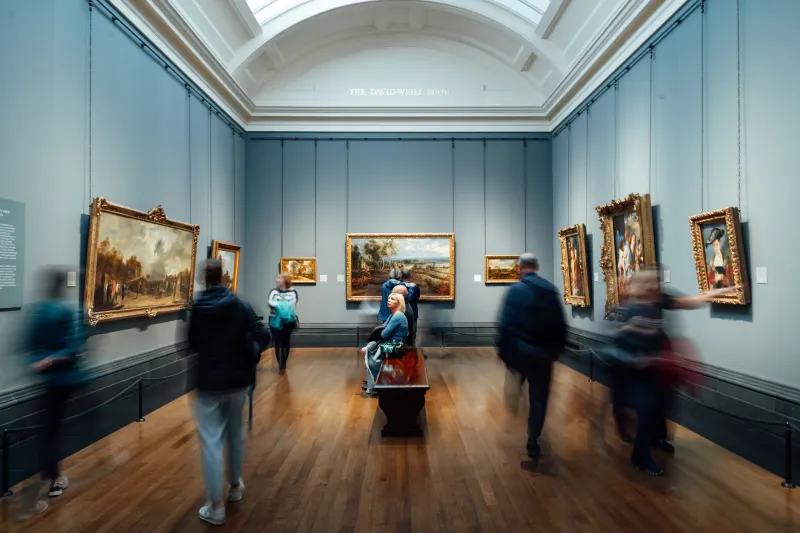
Stand in front of almost any major American painting from the eighteenth or nineteenth century and read the label beside it. You will learn the artist's name, the date of execution, the medium, perhaps a sentence about the work's compositional influences or its place within a broader movement. What you are unlikely to learn — what the label was almost certainly not written to tell you — is the full human context in which the image was made: who labored to produce the wealth that commissioned it, whose land was cleared to build the estate in the background, whose story was edited out of the frame before the artist ever picked up a brush.
This is the silence that a growing number of American curators are trying to address. It is also, many of them acknowledge, one of the most difficult problems in their profession — not because the history is unknown, but because the institutional forces that shape what gets said in a museum gallery are formidable, persistent, and rarely discussed in public.
What the Archive Knows That the Gallery Doesn't Show
The scholarship has, in many cases, long existed. Historians of American art, labor, and material culture have documented for decades the ways in which canonical works of the national collection were produced within, and often celebrated, systems of racial hierarchy and economic exploitation. The plantation landscapes of the antebellum South, the triumphalist images of westward expansion, the portraits of merchant-class patrons whose fortunes were built on the transatlantic slave trade — the archival record on these connections is substantial.
What has lagged behind the scholarship is the gallery. "We know what the research says," one curator at a large American art museum told Ask A Curator. "The question is always: what are we actually going to put on the wall? And that question has a hundred different answers depending on who's in the room when you're making the decision."
Those rooms, curators explain, include not only the curatorial staff but institutional leadership, legal counsel, communications teams, and, frequently, representatives of the donor relationships that fund both the collection and the institution itself.
The Donor Dimension
Few forces shape museum narratives more quietly than the preferences and legacies of major donors. When a gallery bears a family name — when the collection's most prominent works arrived as gifts from estates whose wealth derived from industries or practices that are now subjects of historical scrutiny — the pressure to contextualize carefully is real and often unspoken.
"There are works in our collection where I know exactly what the full story is, and I know that telling it fully would create a conversation about the provenance of the donation itself," said one curator, speaking on condition of anonymity. "That's not a conversation that institutional leadership is always prepared to have. So you find language that's accurate but incomplete. You gesture toward complexity without landing on it."
This practice — what might be called the curatorial hedge — is not unique to any single institution or region. It is a structural feature of how American museums have historically managed the relationship between cultural authority and financial dependency.
The Language of Managed Discomfort
For curators attempting to introduce more complete narratives into existing exhibitions, the challenge is often not resistance so much as inertia. Labels that have hung unchanged for decades carry a kind of institutional momentum. Revising them requires not just new scholarship but new consensus — across curatorial, educational, and communications departments — about how much discomfort a given institution is willing to generate in its galleries.
"We talk a lot about 'meeting visitors where they are,'" one education-focused curator observed, "but that framing can become a way of not challenging where visitors are. If someone comes in with a particular set of assumptions about a painting or an artist, and we calibrate our interpretation to avoid disrupting those assumptions, we're not actually doing our job. We're providing comfort, not knowledge."
The tension between accessibility and rigor is genuine, and curators do not dismiss it. But several noted that the framing of "visitor comfort" has sometimes been deployed strategically to resist interpretive change that is, in fact, well-supported by scholarship and simply inconvenient for other reasons.
Artists Whose Stories Remain Compressed
Beyond the question of how existing works are labeled, there is the question of whose work is collected at all. American museums have made measurable progress in recent years in acquiring works by Black, Indigenous, and other artists of color whose practices were systematically excluded from the canonical collection. But progress in acquisition has not always been matched by progress in contextualization.
"You can hang the work and still tell the wrong story about it," said one curator specializing in American art from the early twentieth century. "If you acquire a painting by a Black artist from the Harlem Renaissance and you present it purely in terms of its formal qualities — its relationship to European modernism, its place in the aesthetic movements of the period — without talking about the conditions under which it was made, the segregated art world the artist was navigating, the critical reception that was shaped by race, then you've included the object and excluded the person."
This compression of context — the reduction of a complex historical subject to an aesthetic object — is, curators argue, one of the more persistent forms of institutional silence. It is also one of the hardest to address, because it can masquerade as the neutral language of connoisseurship.
The Slow Work of Reframing
The curators who are most candid about these dynamics are also, in many cases, the ones most actively working to change them. Across American institutions, there are ongoing efforts to revisit permanent collection labels, introduce interpretive programming that goes beyond what the gallery walls can hold, and build the internal consensus necessary to support more complete historical narratives.
The work is slow, and its results are uneven. But for the curators engaged in it, the stakes are clear. "A museum is a place where a society stores its account of itself," one curator reflected. "When that account has gaps — deliberate gaps, managed gaps — it's not just an intellectual problem. It's a question of what we're willing to say about who we are and who we've been. That's not a question that belongs only to historians. It belongs to everyone who walks through the door."