The Silence in the Conservation Lab: Why Museums Guard Their Restoration Discoveries
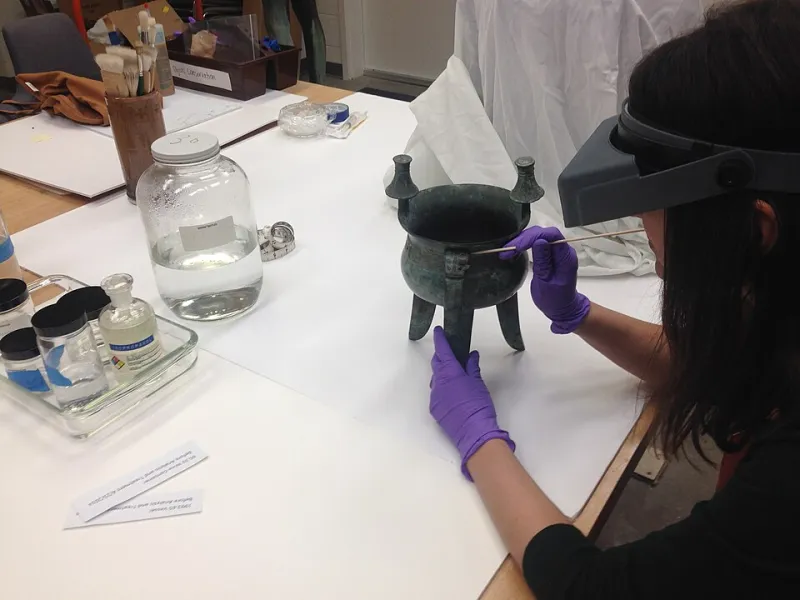
Photo: RichardMcCoy, CC BY-SA 3.0, via Wikimedia Commons
Every major American museum maintains a conservation department — a quiet, climate-controlled world of ultraviolet lamps, X-ray fluorescence scanners, and microscopic paint analysis. The work conducted in these spaces is, by any measure, extraordinary. Hidden portraits discovered beneath famous canvases. Pigments that redate a masterwork by two centuries. Restoration decisions that effectively transform what visitors see on a gallery wall. And yet, the public hears almost none of it.
The question worth asking is not simply what museums are withholding, but why — and whether the institutional logic that has long justified that withholding still holds.
A Culture of Deliberate Discretion
Speak with conservators at major institutions — the Art Institute of Chicago, the Metropolitan Museum of Art, the Getty — and a consistent picture emerges. The conservation lab is, in professional culture, a place of careful words and careful silences. Discoveries are documented meticulously in internal records. They are shared, selectively, with peer researchers and scholarly journals. They are rarely, if ever, communicated proactively to the public.
"There is a longstanding professional norm that conservation findings belong first to the scholarly community," one senior conservator at a large East Coast institution explained, speaking on background. "The idea that a general audience should receive that information in real time is still, for many of us, genuinely new territory."
This norm is not arbitrary. Conservation science is iterative and frequently inconclusive. An X-ray examination might reveal an underdrawing that suggests a work was completed by a different hand — but suggestion is not confirmation. Publishing a preliminary finding, only to retract it eighteen months later when further analysis yields contradictory evidence, carries reputational risk both for the institution and for the work itself. In the art market, where attribution is directly tied to monetary value, a mishandled disclosure can have consequences that extend far beyond the museum's walls.
When Silence Protects the Work — and When It Protects the Institution
The distinction between these two motivations matters enormously, and curators are not always forthcoming about which one is driving a particular decision.
Legitimate scientific caution accounts for a portion of conservation opacity. Announcing that a Rembrandt in your permanent collection may not be a Rembrandt — before the research is complete, before external experts have been consulted, before the institution has determined how to handle the attribution revision — is genuinely irresponsible. The damage to public trust, to donor relationships, and to the work's scholarly standing could be considerable.
But professional caution does not explain every instance of withholding. Several curators, speaking privately, acknowledged that conservation findings are sometimes suppressed because they complicate institutional narratives. A beloved work acquired under celebrated circumstances may carry provenance questions that new technical analysis has deepened rather than resolved. A restoration treatment applied decades ago — and celebrated at the time — may have been revealed by subsequent science to have caused measurable damage. These are not findings that institutions are eager to broadcast.
"Museums are storytelling institutions," one curator observed. "And conservation science sometimes tells stories that conflict with the ones we've already committed to. That tension is real, and it doesn't always resolve in favor of transparency."
The Donor Dimension
In the American museum landscape, the relationship between major donors and institutional decision-making adds another layer of complexity. Works gifted by prominent collectors — or purchased with named endowment funds — carry an implicit expectation of prestige. When conservation analysis raises doubts about authenticity, condition history, or the integrity of a restoration, the implications for donor relationships can be significant.
This is not a hypothetical concern. Several high-profile cases in recent years — including disputes at major encyclopedic museums over works later found to have complicated acquisition histories — have demonstrated how conservation discoveries can become entangled with institutional politics in ways that make straightforward public disclosure difficult.
The pressure to manage these relationships quietly, rather than transparently, is something the field is only beginning to confront directly.
Social Media and the Shrinking Perimeter
For decades, the conservation lab's culture of discretion operated within a relatively contained information environment. Scholarly journals moved slowly. Press inquiries could be managed. The general public had no particular expectation of access to technical research.
That environment no longer exists.
Instagram accounts dedicated to conservation work — including profiles run by the Smithsonian, the MFA Boston, and the Cleveland Museum of Art — have attracted substantial followings by offering glimpses into the restoration process. Behind-the-scenes content performs exceptionally well on social platforms, generating the kind of authentic engagement that institutions increasingly need. The public appetite for this material is, by every available metric, enormous.
But curators are navigating a genuine tension here. The same openness that generates goodwill on social media can also create obligations. If a museum posts a video of conservators examining a work under ultraviolet light, and that examination later yields an uncomfortable finding, the institution has already established a public expectation of transparency that silence will conspicuously violate.
"Social media has made the lab more visible," one conservator noted. "But visibility isn't the same as disclosure. We're very careful about what we show and what we say about what we're showing."
What Visitors Deserve to Know
The ethical question at the heart of this issue is one that the museum field has not yet answered satisfactorily: what do visitors, as the public that museums ostensibly serve, have a right to know about the objects in front of them?
If a painting has been significantly restored — if thirty percent of its surface area reflects the judgment of a twentieth-century conservator rather than the hand of the original artist — is that information material to the visitor's experience? Most curators, when pressed, will acknowledge that it is. Yet wall labels rarely convey it, and public programming almost never addresses it directly.
The argument for greater transparency is not merely ethical. It is also practical. Audiences that understand the complexity of conservation — the uncertainty, the scientific rigor, the genuine difficulty of these decisions — are better equipped to engage with the work on its own terms. They are also, evidence suggests, more forgiving of institutions that acknowledge difficulty than of those that appear to have concealed it.
The Conversation That Needs to Happen
The conservation community in the United States is not monolithic, and there are voices within it pushing for a different approach. A growing number of younger conservators, many of whom came of age professionally in the social media era, are skeptical of the reflexive discretion that has characterized the field. They argue that transparency, managed thoughtfully, strengthens rather than undermines institutional credibility.
What is needed, those voices suggest, is not a wholesale abandonment of professional caution but a clearer, more honest accounting of when caution is genuinely warranted and when it is simply convenient.
Museums ask a great deal of their visitors: sustained attention, intellectual engagement, a willingness to trust that what they are being shown is meaningful and authentic. That trust, once extended, deserves to be honored — not just in the galleries, but in the labs where the real work of understanding these objects actually happens.