Unseen and Undervalued: The Remarkable Artworks Sleeping in America's Museum Storerooms
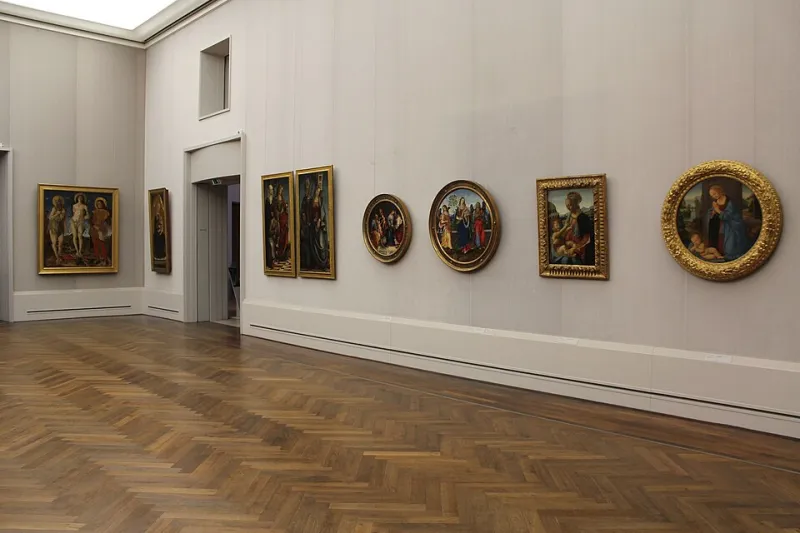
Photo: Oursana, Public domain, via Wikimedia Commons
Imagine a painting of genuine historical significance—beautifully composed, impeccably preserved, made by an artist whose name belongs in any serious survey of American art. Now imagine that painting has not been seen by a member of the public in eleven years. It sits in a temperature-regulated room, cataloged and cared for, waiting.
This is not a hypothetical. Versions of this scenario play out across virtually every major collecting institution in the United States. Industry estimates consistently suggest that the average art museum displays somewhere between five and fifteen percent of its total holdings at any given time. The rest resides in storage facilities that range from purpose-built conservation vaults to repurposed industrial spaces—out of sight, and for most visitors, entirely out of mind.
Ask A Curator spoke with curators at institutions ranging from encyclopedic urban museums to regional collections to understand what is actually down there, why it stays hidden, and whether the situation is finally beginning to change.
What 'Storage' Actually Means
The word conjures images of dusty attics and forgotten boxes. The reality is considerably more sophisticated—and considerably more crowded.
"Our storage facility is, in some respects, better maintained than our galleries," said a registrar and collections manager at a large Southeastern museum. "Controlled humidity, monitored temperature, custom racking for oversized canvases. The works are not neglected. They are simply not displayed."
What fills those racks and shelves varies enormously. At encyclopedic institutions—museums that collect across cultures and centuries—storage may contain archaeological fragments, decorative arts, works on paper too light-sensitive for permanent display, and entire bodies of work acquired through bequest whose breadth far exceeds any single gallery's capacity.
At more focused institutions, the calculus is different. A curator of American art at a mid-sized Midwestern museum described a storeroom containing several dozen paintings from the early twentieth century that have not been exhibited since the 1990s. "Some of them are extraordinary," she said plainly. "There is a landscape in there that I genuinely believe belongs on our main floor. It's not there because we don't have the wall space, and because our current thematic hang doesn't accommodate it without a significant reinstallation."
The Economics of the Unseen
Wall space is the most immediate constraint, but it is far from the only one. The financial architecture of museum collecting creates pressures that are rarely discussed with public audiences.
Accepting a major gift—a collection donated by an estate or a prominent collector—often comes with conditions. Donors may require that a certain percentage of their collection be displayed, or that specific works never be deaccessioned. Institutions eager to secure a prestigious bequest may agree to terms that, over decades, leave them managing holdings that exceed their display capacity by a significant margin.
"We have accepted gifts that were wonderful in many respects and created storage challenges we are still managing thirty years later," acknowledged one curator at a large Northeastern museum. "That's not a criticism of the donors. It's a structural reality of how American museums have historically grown their collections."
Deaccessioning—selling works from the permanent collection—remains one of the most contentious issues in American museum ethics. The Association of Art Museum Directors has strict guidelines governing when and how proceeds from deaccessioned works may be used, and violations can result in serious professional sanctions. The result is that institutions sometimes maintain holdings they cannot display and cannot ethically sell, at significant ongoing conservation cost.
The Works That Deserve a Second Look
Not everything in storage is there by accident. Curatorial priorities shift, and works that were once considered peripheral sometimes turn out to be central.
"We have a significant group of works by women artists from the 1940s and 1950s that were collected almost as an afterthought," said one curator of modern art. "At the time of acquisition, they were not considered major figures. Scholarship has changed dramatically. These are now works I would argue are essential to understanding mid-century American art, and they have been in storage for most of their time with us."
This pattern—of works undervalued at the time of acquisition whose significance is later recognized—recurs across collecting categories. Folk art, craft traditions, and work by artists from communities historically marginalized by the mainstream art world all represent areas where storage facilities may contain holdings whose importance has not yet been fully reckoned with.
Digital Access and the Rotating Exhibition Model
Institutions are not passive in the face of these challenges. Across the country, curators described initiatives designed to extend the reach of invisible collections.
Digital collection databases—publicly accessible online catalogs that include works in storage—have expanded significantly in recent years. The Smithsonian's open access initiative, which made millions of digital images freely available, represents one high-profile example of this trend. Several curators noted that robust online collections have introduced works to researchers and enthusiasts who would never have encountered them in a gallery.
"We have had works contacted for loan requests based entirely on our online catalog," said one collections curator. "A work that had not been exhibited here in fifteen years traveled to three venues in two years because a curator at another institution found it in our database. That's the system working."
Rotating collection displays—gallery spaces dedicated to cycling works from storage on a regular schedule—represent another approach gaining traction. Some institutions have designated entire floors or wings to this purpose, explicitly framing the impermanence of the hang as a feature rather than a limitation.
An Invitation to Look Harder
For the art enthusiast visiting a museum, the knowledge that the galleries represent only a fraction of what the institution holds should prompt a particular kind of curiosity. Ask what else the museum owns. Consult the online collection. Inquire whether study room visits are available—many institutions offer them, giving researchers and engaged members of the public direct access to works not on view.
The curators we spoke with were unanimous on one point: the works in storage are not failures or embarrassments. They are, in many cases, the most compelling argument for returning to an institution again and again.
"A museum is not a finished thing," said one curator, summarizing a sentiment we heard in various forms throughout our reporting. "What you see on any given visit is one version of a much larger, stranger, more interesting collection. The rest of it is waiting."
Curious about what a specific museum holds in its collection? Submit your question through Ask A Curator and we will connect you with an expert who can help.