Off the Pedestal: Curators Speak Honestly About the Works They Struggle to Love

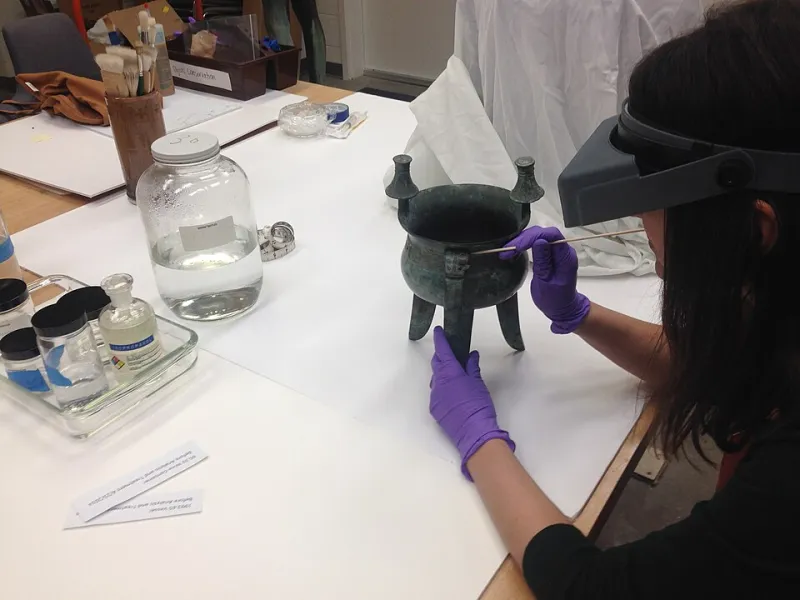
Photo: Ambassador of the United States of America to the People's Republic of China, Public domain, via Wikimedia Commons
There is an assumption, quietly held by many museum visitors, that the people who hang the paintings and write the labels must love everything on the walls. That curatorial expertise implies curatorial enthusiasm. That to study art deeply is, eventually, to adore it completely.
It is a comforting idea. It is also, according to a number of museum professionals who spoke with Ask A Curator, not entirely true.
"We are human beings first," said one senior curator at a major Midwestern institution, who asked to remain anonymous. "We have the same visceral reactions anyone does. The difference is that we've been trained to set those reactions aside—or at least to understand them well enough to work around them."
What follows is an unusually candid look at the private aesthetic lives of curators: the works they find alienating, technically unconvincing, or simply exhausting to defend—and the professional discipline required to serve those works faithfully regardless.
The Weight of Canonical Expectation
For many curators, the most difficult works to champion are not obscure or controversial ones. They are the celebrated icons—the pieces so thoroughly consecrated by art history that any ambivalence feels almost transgressive.
One curator specializing in nineteenth-century European painting described her complicated relationship with a particular Pre-Raphaelite canvas that anchors her museum's permanent collection. "It's technically accomplished, historically significant, and visitors adore it," she said. "But every time I stand in front of it, I feel nothing. The sentiment reads as cloying to me. The color palette, which everyone else finds ravishing, strikes me as overwrought."
She is careful, she emphasized, never to let that private reading inflect her public scholarship. "My job is not to tell visitors how to feel. It's to give them the context and the vocabulary to have their own encounter with the work. My personal response is frankly irrelevant to that mission."
That disciplined separation—between the curator as private person and the curator as public steward—is something professionals describe as a skill developed over years, not a disposition arrived at naturally.
When Reputation Outpaces the Work
Several curators raised a distinct but related frustration: works whose reputations have, in their view, grown disproportionate to what the object itself can sustain.
"There are pieces in this field that have been written about so extensively, mythologized so thoroughly, that the actual physical painting almost disappears behind the scholarship," said one curator at a prominent East Coast research museum. "You stand in front of the thing and you're really just standing in front of a bibliography."
This phenomenon—what he called "reputational inflation"—presents a particular challenge for curators tasked with writing fresh interpretive material for works that have accumulated decades of critical attention. "You're not just describing a painting. You're entering a conversation that started before you were born and will continue long after you retire. Sometimes the honest intellectual response is skepticism. But skepticism doesn't belong on a gallery label."
He was quick to note that his reservations are not about dismissing the scholarship. "The historical importance of a work is real and worth communicating. I just think there's a difference between importance and greatness, and we sometimes conflate the two in ways that don't serve visitors."
Technical Disagreements and the Limits of Training
For curators with backgrounds in studio practice or conservation, aesthetic discomfort sometimes takes a more technical form. One curator who trained as a painter before moving into museum work described her persistent unease with a celebrated twentieth-century abstract work in her institution's holdings.
"The handling of the paint, to me, reads as unresolved," she said. "There are passages that I think any rigorous instructor would have asked the artist to reconsider. But this is a work that defined a movement, that influenced generations. My technical read is just one read, and probably the least important one in this context."
She described the experience of leading docent training sessions around the work as genuinely instructive—not because it changed her opinion, but because it forced her to articulate the work's significance in terms that transcended her own framework. "I had to understand why it mattered to other people, and that understanding is more valuable than my preference."
The Professional Compact
What emerges from these conversations is not cynicism but something more nuanced: a professional compact that curators make, implicitly, when they accept their roles. To serve the collection is to serve it fully, including the works that do not personally resonate.
"I think about it like a public defender," said one curator of contemporary art at a large urban museum. "Your job is to give every client the best possible representation, regardless of your private assessment. A curator who only championed the works they loved personally would be a very poor curator—and a very small one."
There is, several curators suggested, something genuinely educational in that discipline. Working closely with art that resists your instincts forces a kind of intellectual humility that purely enthusiastic engagement cannot produce.
"The works I've written about most carefully are often the ones I liked least at first," said one curator who has spent two decades focused on American modernism. "You have to ask harder questions. You can't coast on enthusiasm. And sometimes—not always, but sometimes—you come out the other side with a real appreciation you never expected."
What Visitors Deserve to Know
The question of whether curators should ever share their reservations publicly is one the professionals we spoke with approached cautiously. Most drew a firm line.
"A gallery is not a venue for my opinions," said one. "It's a space for encounter. My role is to facilitate that encounter, not to position myself between the visitor and the work."
And yet, some suggested that a degree of honest critical voice—carefully framed—might serve visitors better than relentless institutional reverence. "We do visitors a disservice when we treat everything in the collection as equally transcendent," said one curator. "Art history is an argument, not a verdict. Modeling that complexity, including the complexity of disagreement, seems like part of the educational mission."
For now, the private reservations largely remain private—stored in the mental file that curators carry alongside their scholarly training, their institutional loyalties, and their genuine love for the discipline that brought them to this work in the first place.
"I don't resent the works I struggle with," said the nineteenth-century specialist. "They're part of the job. And honestly, they keep me honest."